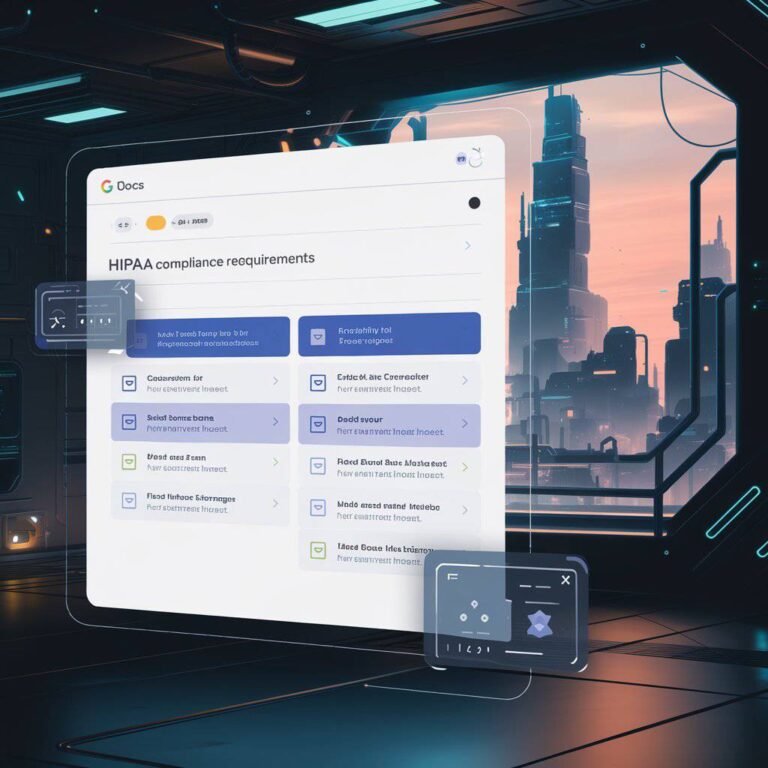
Maintaining compliance with the Health Insurance Portability and Accountability Act (HIPAA) can make navigating the world of document management in the healthcare industry a challenging and important undertaking. As a small business in the healthcare industry, it is critical that the platforms and technologies you employ adhere to HIPAA regulations. The well-known cloud-based document processing application Google Docs, which is provided by Google, has drawn criticism for its suitability for HIPAA compliance. For healthcare organizations and business colleagues looking for a dependable document solution that conforms with HIPAA requirements, we will examine Google Docs and its compliance with HIPAA rules in this article.
Understanding HIPAA Compliance
Importance of HIPAA for Healthcare Organizations
The Health Insurance Portability and Accountability Act, or HIPAA, establishes the benchmark for safeguarding private patient information. Following HIPAA is not only required by law, but it is also essential for healthcare institutions to maintain patient trust. In order to ensure that data is shared and stored safely, it requires safeguards for handling personal health information (PHI). Significant fines, reputational harm, and a decline in patient confidence can result from noncompliance with HIPAA. Additionally, it establishes guidelines for the use and disclosure of PHI, establishing the groundwork for moral healthcare practices. Maintaining operational integrity and creating a safe environment for patients and employees requires that all healthcare organizations, from hospitals to small and medium-sized healthcare providers, comprehend and apply HIPAA’s requirements.
How Business Operations Are Affected by HIPAA Compliance
Healthcare organizations’ business operations are revolutionized by HIPAA compliance. It necessitates a strong framework for handling patient data, including everything from staff training to the IT infrastructure. Managing PHI securely becomes a top operational responsibility, requiring specific systems and procedures. Budgeting may be impacted if security or compliance software purchases may be required. Employees also need to be knowledgeable with HIPAA regulations, which frequently calls for regular training and process updates. Penalties are only one aspect of non-compliance; another is the disruption of company continuity. Business loss, legal issues, and operational disruption can all arise from a data breach or noncompliance. Thus, maintaining HIPAA compliance is essential for both legal compliance and guaranteeing seamless and continuous business operations in the healthcare industry.
HIPAA Compliance with Google Docs
An Overview of Google Docs
The Google Workspace package includes the popular cloud-based word processor Google Docs. Its online document creation, editing, and sharing capabilities, along with real-time collaboration tools, have completely changed how we operate. A few of its main advantages are that it can be accessed from any internet-connected device, that it can log changes, and that it allows multiple people to collaborate on a same document at once. The issue of HIPAA compliance, however, becomes crucial when using Google Docs for medical services. When evaluating a platform’s suitability for managing PHI, its security features, data encryption processes, and user access controls are crucial factors. Although Google Docs was created with user-friendliness and productivity in mind, healthcare businesses place the greatest emphasis on the compliance procedures that go on behind the scenes.
Answering the Question: Does Google Docs Comply with HIPAA?
Understanding the safeguards Google has in place to secure sensitive data is necessary to ascertain whether Google Docs complies with HIPAA. If certain requirements are fulfilled, Google Docs itself can be utilized in a way that complies with HIPAA. The most important thing is a business associate agreement (BAA) with Google. This agreement between Google and a HIPAA-covered organization outlines each party’s obligations to protect PHI. Additionally, businesses need to set up Google Workspace so that PHI is managed in compliance with HIPAA regulations. This covers appropriate encryption techniques both in transit and at rest, audit controls, and access controls. Although Google offers the resources required to facilitate HIPAA compliance, the healthcare organization is ultimately in charge of using Google Docs in a manner compliant with HIPAA rules. Thus, if Google Docs is implemented correctly and security procedures are followed, it can be a component of a HIPAA-compliant solution.
HIPAA Compliance and the Business Associate Agreement at Google
When using Google Docs, a Business Associate Agreement (BAA) with Google is a crucial step in guaranteeing HIPAA compliance. This contract is crucial because it contains Google’s pledge to handle PHI securely, including the safeguards and obligations they both agree to maintain. According to Google, their services will be used in a way that complies with HIPAA regulations. All audits and reviews require access control, data encryption, and the ability to retrieve audit logs, all of which are covered by the BAA. Importantly, though, the BAA by itself does not certify an organization as HIPAA compliant. The appropriate use of security features, data governance guidelines, and employee training are all components of a broader compliance approach. Businesses need to be very careful about how they utilize Google Docs to make sure that these procedures are followed and that they comply with the BAA’s requirements.
Improving Adherence to Google Docs
Google Docs: Best Practices for HIPAA Compliance
Implementing best practices that go beyond simply signing a BAA with Google is crucial to improving HIPAA compliance while utilizing Google Docs. Begin by limiting access to PHI by making sure that only authorized users can read or edit sensitive documents using Google’s permissions settings. Examine these permissions frequently and make any required adjustments. Next, track who has accessed or altered documents containing PHI by using the audit trail tool. Make sure data is encrypted both in transit and at rest, and enable two-factor authentication for an extra degree of protection. Make sure to train employees thoroughly on HIPAA regulations and how they relate to Google Docs. Finally, in the event that PHI is accessed without authorization, have a well-defined incident response plan in place. By following these guidelines, you can make sure that Google Docs is used securely and legally.
Case Studies: Google Docs’s Effective HIPAA Compliance
Examples from the real world demonstrate that healthcare organizations may successfully manage PHI with Google Docs. By adopting Google Sheets and Forms, for example, a mid-sized clinic was able to expedite their patient intake procedure while guaranteeing that all data was safeguarded by a signed BAA with Google. The clinic stayed in compliance with HIPAA by enforcing stringent access controls and carrying out frequent audits. In another instance, a telehealth service provider used Google Docs to create patient care plans. By using end-to-end encryption and providing their employees with thorough training on HIPAA’s privacy and security regulations, they were able to achieve compliance. These case studies demonstrate how healthcare providers can take advantage of Google Docs’ robust capabilities while still adhering to the strict HIPAA regulations by paying close attention to security settings, training staff, and following Google’s BAA.
In Future HIPAA Compliance & Google Docs
It’s possible that Google Docs will keep developing in the future with new capabilities that help with HIPAA compliance. Platforms like Google Docs must continue to lead the way in security and compliance with cloud-based services as they become more and more essential to healthcare operations. We should expect to see more advanced access controls, encryption technology, and even AI-powered monitoring systems that instantly identify possible compliance problems. Google has made a significant commitment in compliance, as seen by their present products, and their upcoming releases are likely to closely follow the changing rules governing healthcare. To ensure that their use of Google Docs continues to satisfy the strict criteria of HIPAA compliance, healthcare organizations must remain up to date on the latest updates and improvements to the program.